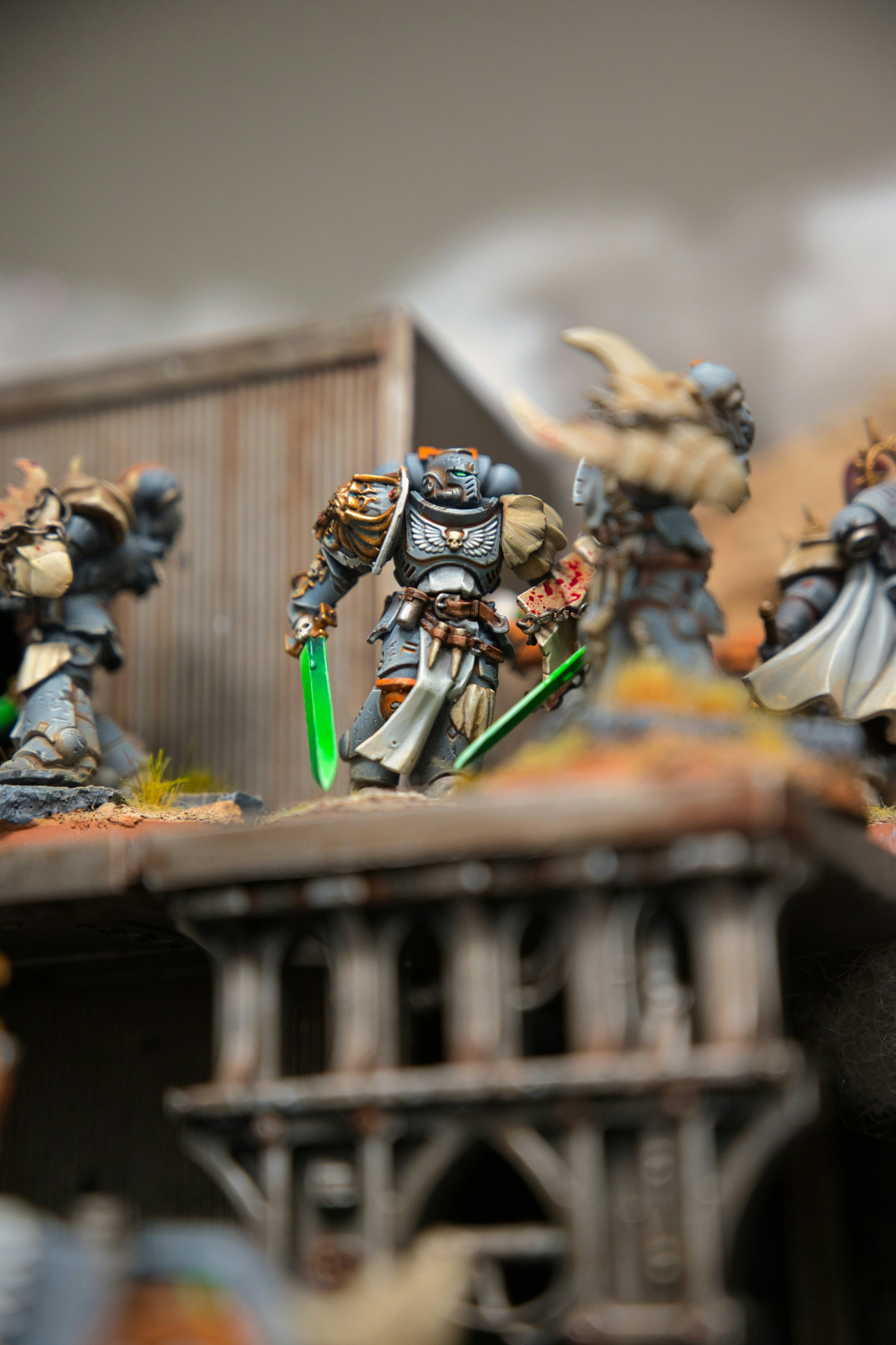
Warhammer began as a tabletop game in 1983. It now appears in novels, magazines, and digital games, while the model-making and tournament scenes continue to grow. The scholarly literature remains surprisingly small for a cultural property of its size and age.
This bibliography is selective and limited to research articles and book chapters. I have favoured work that identifies what it studied and makes a sustained argument. The choices are mine. The Warhammer Conference Academic Archive provides a broader list.
If you think an article or chapter should be added, send me the citation.
The third annual Warhammer Conference will take place on 26–27 September 2026 at the Frankfurt Institute for Advanced Studies. Abstract submissions are closed.
Play, rules, and competition
Carter, M., Gibbs, M., & Harrop, M. (2014). Drafting an army: The playful pastime of Warhammer 40,000. Games and Culture, 9(2), 122–147.
Timonen, A. (2025). Cheese vs. fluff: The temporal shift of metagame and paragame in Warhammer. ACM Games: Research and Practice, 3(2), 1–11.
Singleton, B. E. (2021). “We offer Nuffle a sausage sacrifice on game day”: Blood Bowl players’ world-building rituals through the lens of theory of sociocultural viability. Journal of Contemporary Ethnography, 50(2), 176–201.
Lindahl, O. K. V., Timonen, A., & Meriläinen, M. (2025). Why did you pick that army? Player personality traits and faction choice in the miniature wargame Warhammer Fantasy Battle. Imagination, Cognition and Personality, 45(2), 137–158.
Buthaud, M. (2022). Wargames as realistic tabletop simulations of fictional events: The case of Warhammer games. Représentations dans le monde anglophone, 25, 173–192.
Miniaturing, collecting, and craft
Meriläinen, M., Stenros, J., & Heljakka, K. (2020). More than wargaming: Exploring the miniaturing pastime. Simulation & Gaming, 51(5), 684–706.
Williams, I., & Tobin, S. (2022). The practice of Oldhammer: Re-membering a past through craft and play. Games and Culture, 17(4), 576–592.
Smith, T. B. M. (2025). Miniature mindfulness: Finding spiritual flow with Warhammer 40,000 models. Religions, 16(2), 121.
Williams, I. (2025). Defining the miniatures wargame: Five pillars. Analog Game Studies, 12(4), 213–229.
Meriläinen, M., Heljakka, K., & Stenros, J. (2025). “More is more”? Reconsidering the pile of shame. In I. Costas Batlle (Ed.), The Psychgeist of Pop Culture: Warhammer (pp. 20–34). Psychgeist & Play Story Press.
Communities, markets, and publishing
Cova, B., Pace, S., & Park, D. J. (2007). Global brand communities across borders: The Warhammer case. International Marketing Review, 24(3), 313–329.
Baker, N., & Mosier, D. T. (2026). Warhammer serial paratext: A Games Workshop business strategy. Games and Culture. Advance online publication.
Baker, N. (2025). The Warhammer product and service portfolio: Wayfinding information as competitive advantage. In M. J. P. Wolf (Ed.), Navigating imaginary worlds: Wayfinding and subcreation (pp. 116–131). Routledge.
Sturrock, I., & Wallis, J. (2016). Total global domination: Games Workshop and Warhammer 40,000. In P. Harrigan & M. G. Kirschenbaum (Eds.), Zones of control: Perspectives on wargaming. MIT Press.
Politics, history, and representation
Brown, C. M. (2024). Towards generic fascism: Right-wing totalitarian aspects in the universe of Warhammer 40,000. Croatian Political Science Review, 61(2), 29–51.
Hermann, J. (2026). Grimdark Ages: On the neomedievalism of Warhammer 40,000. Das Mittelalter, 31(1), 195–211.
Muñoz-Guerado, A., & Triviño-Cabrera, L. (2018). The erasure of female representation in geek spaces as an element for the construction of geek identity: The case of Warhammer 40,000. Catalan Journal of Communication & Cultural Studies, 10(2), 193–211.
Etherington, J. (2022). Satirical sleight of hand in Warhammer 40K: Space Marines and hegemonic masculinity. SFRA Review, 52(4), 70–78.
Walliss, J. (2010). Girls go slash/boys go bang: Gender, canon and creativity within Warhammer 40,000 fanfiction. Popular Culture Review, 21, 49–62.